How to Improve Your EPC Rating: What Works in Birmingham Homes (2026)
An EPC rating goes up when the property itself changes: more insulation, a better heating system or better controls. It doesn't go up because you've cleaned, decorated or fitted a smart meter. This guide uses the government's own EPC register to show which improvements are recommended most for Birmingham homes, what they cost, and what a better rating is worth.
Short answer: Fix the fabric first: loft insulation, cavity wall insulation and floor insulation where they're missing. Then heating controls, the boiler and the hot water cylinder. Then lighting. Solar panels and heat pumps move the score most, but cost the most. The rating only changes when a new EPC is lodged, so get reassessed after the work.
How is an EPC rating worked out?
The rating comes from a standard calculation of how much energy the home needs for heating, hot water and lighting, based on what the assessor records: the walls, roof and floors, the windows, the heating system and its controls, the hot water and the light fittings. It assumes standard occupancy, so it rates the building, not the way you live in it. That is why only physical changes move it. My guide to EPC ratings explained covers what each band means.
How much could your rating improve?
Every certificate shows a potential rating alongside the current one: what the property would score if the recommended measures were carried out. Across the 204,412 certificates lodged for Birmingham homes between January 2021 and September 2026:
- Today, 44.4% are rated C, 36.9% D and 7.8% E, F or G.
- At their potential rating, 50.5% would be A or B and 46.0% C. Only 3.5% would be left at D or below.
- The typical gap between current and potential is 12 points.
- 64% of homes could move up at least one band, and 24% two bands or more.
What the register recommends for Birmingham homes
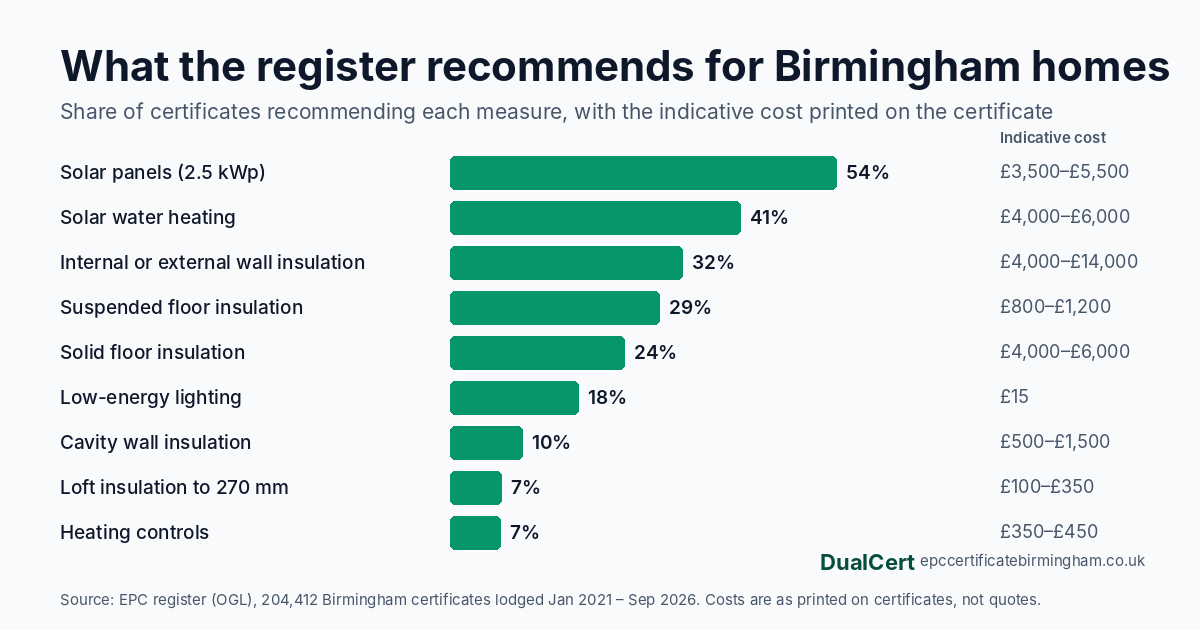
These are the measures recommended most often on certificates for Birmingham homes since 2021, with the indicative cost printed on the certificate. Those costs are the ones in the assessment software at the time, so treat them as a rough guide rather than a quote.
| Recommended measure | Share of certificates | Indicative cost on certificate |
|---|---|---|
| Solar panels (2.5 kWp) | 54% | £3,500 – £5,500 |
| Solar water heating | 41% | £4,000 – £6,000 |
| Internal or external wall insulation | 32% | £4,000 – £14,000 |
| Suspended floor insulation | 29% | £800 – £1,200 |
| Solid floor insulation | 24% | £4,000 – £6,000 |
| Low-energy lighting in all fixed outlets | 18% | £15 |
| Cavity wall insulation | 10% | £500 – £1,500 |
| Loft insulation topped up to 270 mm | 7% | £100 – £350 |
| Upgraded heating controls | 7% | £350 – £450 |
| New condensing boiler | 5% | £2,200 – £3,000 |
Two things stand out. Cheap measures like loft and cavity insulation appear on relatively few certificates, because most Birmingham homes already have them. And the expensive measures appear on many, because once the cheap gaps are closed, what's left costs more. So the right first step depends on your own certificate: its recommendations are listed in order for that property.
The improvements that move the rating most
Insulation: fix the fabric first
- Loft insulation. The assessor measures the depth. Topping a thin layer up to 270 mm is cheap and quick.
- Cavity wall insulation. If the walls have an empty cavity, filling it is one of the best-value measures there is.
- Floor insulation. Suspended timber floors can be insulated from below for far less than a solid floor.
- Solid wall insulation. The big one for older homes: internal or external insulation. Effective, but expensive and disruptive.
Heating and hot water
- Heating controls. A programmer, a room thermostat and thermostatic radiator valves. Cheaper than a new boiler and often missing.
- The boiler. Replacing an old, non-condensing boiler helps. Replacing a working modern one purely for the rating rarely pays.
- The hot water cylinder. A cylinder jacket costs about £30, according to the Energy Saving Trust.
- Heat pumps. The 674 Birmingham homes heated by a heat pump since 2021 have a median score of 84, and 90% are rated C or better.
Lighting and renewables
- Low-energy lighting. Cheap, but the Energy Saving Trust notes it isn't likely to make a huge difference to the rating on its own.
- Solar panels. The most common recommendation in the table above. Homes with solar panels in Birmingham have a median score of 78, against 68 for homes without, although homes with panels often have other improvements too.
Solid walls: the Birmingham problem
About a third of Birmingham certificates since 2021 (34%) record solid brick walls, common in the city's Victorian and Edwardian terraces. Those homes have a median score of 64, against 71 for cavity-walled homes, and only 26% are rated C or better, against 67%.
That doesn't mean an older house can't reach C, a quarter of them already have. It means the route is different: with no cavity to fill, the gains come from the loft, the floors, heating controls and the boiler first, and wall insulation only if those aren't enough.
What doesn't improve your EPC rating
- A smart meter. It shows you what you use. It doesn't change the building, so it doesn't change the rating.
- Replacing windows that are already double glazed. Replacing single glazing is a recommendation on about 3% of Birmingham certificates; swapping one double glazing for newer double glazing moves the score very little.
- Technology before fabric. Solar panels on a house with an uninsulated loft is the expensive way round.
- Decorating, cleaning and appliances. Fridges, cookers and TVs aren't part of the calculation.
Does a better EPC rating increase your house value?
The most-quoted evidence is Rightmove's research published in October 2021. It looked at over 200,000 homes on Rightmove that sold twice, with a better EPC rating the second time, adjusting for house price growth and size. On average, the sold-price premium was:
- 16% for moving from F to C;
- 8% for E to C;
- 4% for D to C.
It's one study, published by Rightmove itself, and it shows an average, not what your house will do. Rightmove's own comment was that the cost of the work has to be weighed against the gain. The practical reading: if your home is D or below, the cheap measures that lift it to C are the ones most likely to pay for themselves at sale. If you're selling, see whether you need a new certificate in my guide to selling with an EPC.
How to get from D to C
Usually it is two or three measures rather than one big job, because the gap between a high D (score 55 to 68) and a low C (69 to 80) can be a handful of points. Start with the recommendations on your own certificate, do the cheapest measures that carry the most points, then get reassessed. For landlords working towards the planned band C standard, my guide to EPC rules for landlords has the dates and the cost cap.
After the work: get a new EPC
Your rating doesn't update itself. The register keeps showing the old certificate, and buyers and tenants see the old rating, until a new assessment is lodged. Keep the paperwork for any work that can't be seen, such as insulation certificates or the boiler installation record, because evidence lets the assessor record the improvement properly.
A new EPC from me costs £65 to £95 depending on size, paid on the day, with no booking fee. You can request a booking online or ring 07365 061790.
Common questions
Does a smart meter improve your EPC rating?
No. A smart meter shows you what you use, but the rating is calculated from the building's construction, insulation, heating, hot water and lighting. A smart meter changes none of those.
Do LED bulbs improve your EPC rating?
A little. The calculation counts the proportion of fixed light fittings that are low-energy, so it's worth finishing the job, but lighting on its own rarely moves a band.
Does a new boiler improve your EPC rating?
Replacing an old, inefficient boiler with a modern condensing one helps. Adding proper heating controls is often the cheaper first step.
Do solar panels improve your EPC rating?
Usually, yes, and they are the most common recommendation on Birmingham certificates. It's normally better value to fix insulation gaps first.
Need an EPC in Birmingham?
I provide fast, accredited energy assessments across Birmingham, Solihull and Redditch. Prices start from just £65 with a 36-hour turnaround.