EPC Myths vs Facts: 10 Things People Get Wrong About EPCs
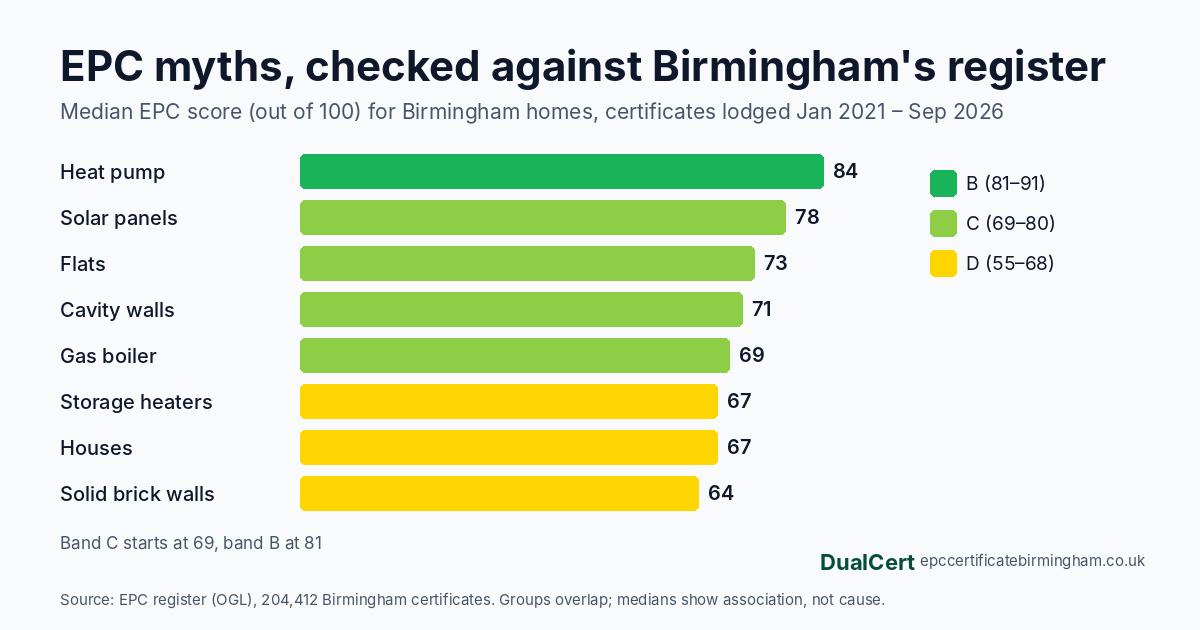
A lot of what people believe about EPCs is half-remembered from a friend's house sale or a landlord forum. Here are ten of the most common myths, checked against the rules and against the government's own register of every certificate lodged in Birmingham.
Short answer: You can't fail an EPC, a smart meter won't change it, new builds aren't always A, electric heating usually scores lower than gas, and an old house can still reach C. You need an EPC to sell even without an agent, but one certificate lasts ten years.
The Birmingham figures below come from the 204,412 certificates lodged for Birmingham homes between January 2021 and September 2026.
Myth 1: "You can fail an EPC"
Fact: There's no pass or fail. An EPC rates the property from A, the most efficient, to G, the least, and lists what would improve it. The only threshold that works like a pass mark is for renting: a let property must currently be band E or above unless a valid exemption is registered. There is no minimum rating to sell.
Myth 2: "A smart meter improves my rating"
Fact: A smart meter shows you what you use. The rating is calculated from the building's construction, insulation, heating, hot water and lighting, under standard assumptions about how a home is used, so a smart meter changes nothing in it. My guide to how to improve your EPC rating covers what does.
Myth 3: "I don't need an EPC if I sell privately"
Fact: The legal duty to have an EPC sits with the seller, not the estate agent. Selling privately, online or to someone you know, you still need one, ordered before the property is marketed. The full rules are in do you need an EPC to sell a house?
Myth 4: "You need a new EPC every time you sell or let"
Fact: An EPC lasts ten years, however many times the property is sold or let in that time. Check for a valid one on the government's Find an energy certificate service before you pay anyone. The reason to get a new one early is if you've improved the property, because the old rating keeps appearing in every advert until a new certificate is lodged.
Myth 5: "I can do my own EPC"
Fact: Only an accredited domestic energy assessor can carry out the assessment and lodge the certificate on the national register. Online calculators can give you a rough idea, but they don't produce an EPC.
Myth 6: "New builds are always rated A"
Fact: Of the 18,169 new-build certificates lodged in Birmingham since 2021, 3.9% were rated A. Three in four (75.3%) were rated B, and 18.3% C. New homes are efficient, but A usually needs solar panels or other on-site generation on top of good insulation.
Myth 7: "Electric heating rates better than gas"
Fact: Usually the opposite, because the calculation reflects running cost as well as efficiency. In Birmingham:
- Homes heated by a mains gas boiler: median score 69, and 0.2% rated F or G.
- Homes heated by electric storage heaters: median score 67, and 4.3% rated F or G.
- Homes heated by a heat pump: median score 84, and 90% rated C or better.
So electric heating can score well, but it's heat pumps doing it, not storage heaters or panel heaters.
Myth 8: "An old house can't get a C"
Fact: Older homes with solid brick walls do find it harder: in Birmingham they have a median score of 64, against 71 for cavity-walled homes. But 25.5% of solid-walled homes are already rated C or better. The route is different: the loft, floors, heating controls and boiler first, and wall insulation only if needed.
Myth 9: "An EPC checks for damp and safety"
Fact: An EPC is an energy assessment and nothing more. The assessor records construction, insulation, heating, hot water, glazing and lighting. It doesn't check for damp, structural problems, gas safety or electrical safety; those need a surveyor or the relevant engineer. Here is what an EPC assessor actually looks at.
Myth 10: "The EPC tells me what my bills will be"
Fact: The estimated costs on a certificate are worked out under standard assumptions about heating patterns and occupancy, so different homes can be compared fairly. Your real bills depend on how many people live there, how warm you keep it and your tariff. Use the figures to compare properties, not to predict your bill.
The one that is mostly true: "Flats rate better than houses"
This one holds up. Birmingham flats have a median score of 73 and 71% are rated C or better, against 67 and 44% for houses. Flats lose less heat, because they share walls, floors and ceilings with heated neighbours. A top-floor or ground-floor flat with an exposed roof or floor can still rate lower than the flat in the middle.
Getting an accurate EPC
The rating records what is there, evidenced where evidence exists, so keep paperwork for anything that can't be seen, such as insulation certificates or boiler installation records. My prices are £65 to £95 depending on size, paid on the day; the reasons prices vary are in how much an EPC costs in Birmingham. You can request a booking online or ring 07365 061790.
Common questions
Can you fail an EPC?
No. An EPC isn't a pass or fail test: it rates a property from A to G. The only threshold that works like a pass mark is for letting, where a rented home must currently be band E or above unless an exemption is registered.
Can I do my own EPC?
No. Only an accredited domestic energy assessor can carry out the assessment and lodge the certificate on the national register.
Are new build homes always rated A?
No. Of new-build certificates lodged in Birmingham since January 2021, 3.9% were rated A, 75.3% B and 18.3% C.
Is electric heating better for an EPC rating than gas?
Not usually. Storage heaters score lower than gas boilers on average in Birmingham. Heat pumps are the exception, with a median score of 84.
Need an EPC in Birmingham?
I provide fast, accredited energy assessments across Birmingham, Solihull and Redditch. Prices start from just £65 with a 36-hour turnaround.